
Ever-reforming PC(USA) congregations
January 06, 2026
By Lea Sitton, Lead, Agency Communications
This is the second in a series of articles looking at the state of Christianity in America and the ways in which congregations in the Presbyterian Church (U.S.A.) are renewing and reforming to continue building the body of Christ.
I am about to do a new thing;
now it springs forth, do you not perceive it?
- Isaiah 43:19
Earlier this year, the Board of Pensions of the Presbyterian Church (U.S.A.) wrote about the
academic debate over the future of Christianity in the U.S. Studies show the decline in traditional religion has stabilized but is likely to resume. Church buildings are being repurposed and razed as congregations in mainline denominations respond to contracting membership. At the same time, congregations like the four below are being reborn and injecting life back into their communities by responding to need.
Riverview United Presbyterian Church, Pittsburgh
When the Reverend Steven Werth started serving Riverview United Presbyterian Church in 2014, the congregation figured it had the resources to keep going for five to 10 years. Rev. Werth checked out the annual reports. “There were two years,” he said.
Not wanting to be “a church that lets its building kill it,” as one member of session put it, Riverview sold its campus to a nondenominational congregation and is now joyfully reforming. The congregation — itself formed in a 1977 merger of three congregations dating to the late 1800s — is merging with Community House Presbyterian Church.
The melding of congregations began in 2018 when Community House lost its minister, and members asked Rev. Werth to moderate their session. Then, in 2020, the congregations joined a pilot of the
Shared Ministry Program, the Board of Pensions program that provides benefits subsidies to two or more congregations that create a sustainable pastoral position. “That really was the catalyst for them to really have to think about what it meant not to just share resources but pray for each other,” said Rev. Werth, who now pastors both congregations.
The two congregations are becoming
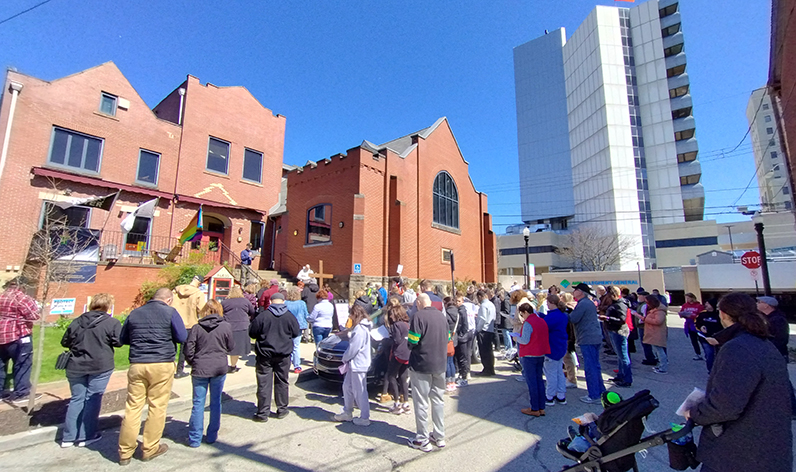
Beloved Community Presbyterian Church. Riverview has moved into the Community House building, at the heart of the city’s North Side neighborhood. It’s “a very, very urban neighborhood,” Rev. Werth said, with poverty and homelessness alongside gentrification. Members have leaned deeply into Community House’s history of welcoming and supporting the LGBTQIA+ community.
With six food distribution centers in the neighborhood, Riverview’s food bank was no longer needed. Instead, the congregations added the Blessing Box at the sidewalk, with hygiene products and everyday household supplies. They also operate the Free Store, offering clothing and a range of other items, such as housewares and diapers. Partnership with a local dollar store allows them to get products nearing expiration at greatly reduced costs, said Rev. Werth, adding that the congregations directly served 5,500 people in North Side in 2025.
The Community House building generates revenue by leasing space to the community, Rev. Werth said. A Baptist congregation that had been in Riverview moved into Community House, and a community development organization also leases space.
The congregations also added The Bunkhouse, offering hostel-style lodging and connections to local nonprofits for service opportunities.
“There were some tense places,” Rev. Werth said of the journey to the union of the two congregations. “But I always had the sense that God was doing something amazing here. We just needed to be responsive to that.”
New Hope Presbyterian Church, Anaheim, California
New Hope Presbyterian Church flourishes in part because two congregations had the courage to dream bigger than themselves. New Hope was born of St. John’s Presbyterian in Compton, California, which closed in 1967. Moved by the Civil Rights Movement, the White congregation directed its assets be used to plant an African American congregation in Orange County, where Blacks made up less than 1% of the population.
In 2001, Marionette Oliver uncovered the long-forgotten St. John’s legacy. In
a video about New Hope, she joyfully remembers the find. “We had been told that would never happen in Orange County,” she said of having an African American Presbyterian church in the county.
After several years of research, the Reverend Chineta Goodjoin was asked to help plant the congregation. And by December 2017, New Hope was a chartered church nested in First Presbyterian Church of Orange.
Meanwhile, membership in the mostly White congregation of St. Paul’s Presbyterian in Anaheim was dwindling but still holding onto its dream of keeping ministry alive on its large campus. In late 2019, St. Paul’s asked to meet with Rev. Goodjoin.
“We were able to see we had common values,” Rev. Goodjoin said. The congregation told her, “We will give you the property if you promise to maintain it.” All four of St. Paul’s buildings were in decline, and the sanctuary needed to be rebuilt. New Hope got the work done with grants and donations — and enfolded artifacts from St. Paul’s in the new church.
“We wanted them to feel like they were part of a new day coming,” Rev. Goodjoin said. Above the large stained-glass cross that was designed as the centerpiece of the new sanctuary are the words from the King James version of Psalm 150:1 that had been above St. Paul’s chancel: PRAISE YE THE LORD.
You matter runs across the cross, along with hands that can seem to change color, capturing New Hope’s commitment to inclusion. A loaf of bread symbolizes the ministry of caring for community that St. Paul’s practiced and that lives on with New Hope. And a drum symbolizes the rich music ministry that’s unique to New Hope.
The ministry that began on a small scale has been able to blossom on the new, large campus. Last year, the congregation launched
New Hope Orange County Orchestra, the first in the county entirely composed of musicians of color. All ages are accepted and at no cost. They practice at New Hope, coached by mostly volunteers, all of whom are musicians of color, modeling the possible.
“We are thriving because we are touching people’s lives,” Rev. Goodjoin said.
Riverside Presbyterian Church, Sterling, Virginia
When Riverside Presbyterian Church began gathering in Potowmack Elementary School as a church plant in 1996, it already owned a vacant five-acre lot, donated by a prominent developer and Presbyterian. But by the time the congregation was big enough to consider raising a church, development around the acreage had made parking tight and the cost of building a church had ballooned.
The congregation sold the vacant land in 2014 and now owns one-half of an office building, with parking for Sunday churchgoing, space for community members to lease, and Riverside’s own Ridgetop Coffee & Tea. “We wanted the building to pay for itself and the mission dollars to pay for mission,” said the Reverend Edwin Andrade, senior pastor. Riverside is about fostering community. “The most important thing we do is not Sunday morning,” he said.
Since opening in 2017, the coffee shop and its toddler playground have become a popular gathering spot for parents with young children. When Sunday school is in session, the playground is Riverside’s nursery, and all are welcome, whether their parents are church members or not. “We’ve had families that have met us through the coffee shop,” Rev. Andrade said.
Ridgetop also draws 35 to 40 high school students every Tuesday morning before school. “Every kid gets a free drink,” Rev. Andrade said. “Many of them are not members. … They bring their friends, and they’re inviting people. We’re trusting that the relationship will keep guiding.”
Riverside’s outreach doesn’t stop at Ridgetop. The congregation partners with Sugarland Elementary School, where over 60% of students qualify for free or reduced lunch, supporting its families year-round. Riverside also supports Faith Chapel Gathering Place, in the nearby hamlet of Lucketts. Faith Chapel houses a food pantry and Faith Chapel Messy Church as well as an arts hub. The building is a former Presbyterian Church, which closed in 2015 after 130 years.
Rev. Andrade himself is a symbol of Riverside’s outreach. When church members saw the Hispanic population around them growing, they called Rev. Andrade in 2006 to lead worship services in Spanish. Riverside continues to offer worship in both languages, giving the different generations of Spanish speakers a choice.
If Riverside did not offer both options, it would lose at least one generation, Rev. Andrade said, adding that Riverside has one youth group, one session, and one budget. “We are one church.”
New River Presbyterian Church, Philadelphia
The Reverend Dr. Eustacia Moffett-Marshall arrived in Philadelphia in 2019 to lead three congregations into one. But just eight months later, COVID-19 shut everything down. As a result, members were “forming and shaping this new community on Zoom,” the pastor said.
New River Presbyterian Church emerged from three years on Zoom, reflecting the ministries of First African Presbyterian Church, the first Black Presbyterian church, founded in 1807 by the Reverend John Gloucester; Good Shepherd Presbyterian Church, dating to 1856 and the Reverend Nathaniel West’s street-corner preaching mission; and Calvin Presbyterian Church, established in 1902 as the Sunday School mission of another church.
Dwindling membership and aging buildings plagued the congregations. The Presbytery of Philadelphia was exploring a union with members of First African and Calvin when fire destroyed Good Shepherd’s building in 2016.
Good Shepherd was asked, “‘Would you consider joining the conversation?’ So we did,” elder Cheryl Logan said. Elder Lois Hayman-El, formerly of First African, said that “people were really being invested in their identity. It took some time.” Lorraine P. McKenzie, who grew up in Calvin and is Clerk of Session at New River, agreed. “We were so different,” she said, but added, “God’s calling us to reform and be reforming. … There’s a synergy going on. I can feel it.”
The initial plan was to find a fourth location for New River. "So much of their sacred history was tied to the brick and mortar,” Rev. Moffett-Marshall said of the congregations. After nothing was found, New River moved into First African, beginning the journey of fundraising and grant writing to restore the property.
In a community where nearly 50% of the households are below the poverty line, New River is rising to meet the needs of the neighborhood. The land where Good Shepherd stood became affordable senior apartments, which opened this year. A free medical clinic operates out of New River, and the congregation runs a food pantry, an emergency fund for seniors, and various outreach events, like block parties.
Rev. Moffett-Marshall has spurred the establishment of a community development corporation (CDC). The Three Streams CDC is harnessing public, private, and faith-based support for a mixed-use development next to New River with affordable housing, a commercial corridor, and space for urban farming.
“We are actually bearing witness to what Jesus is all about,” Rev. Moffett-Marshall said. “We expect to see people impacted.”

Share this article